Artist Interview: Caleb L'Etoile
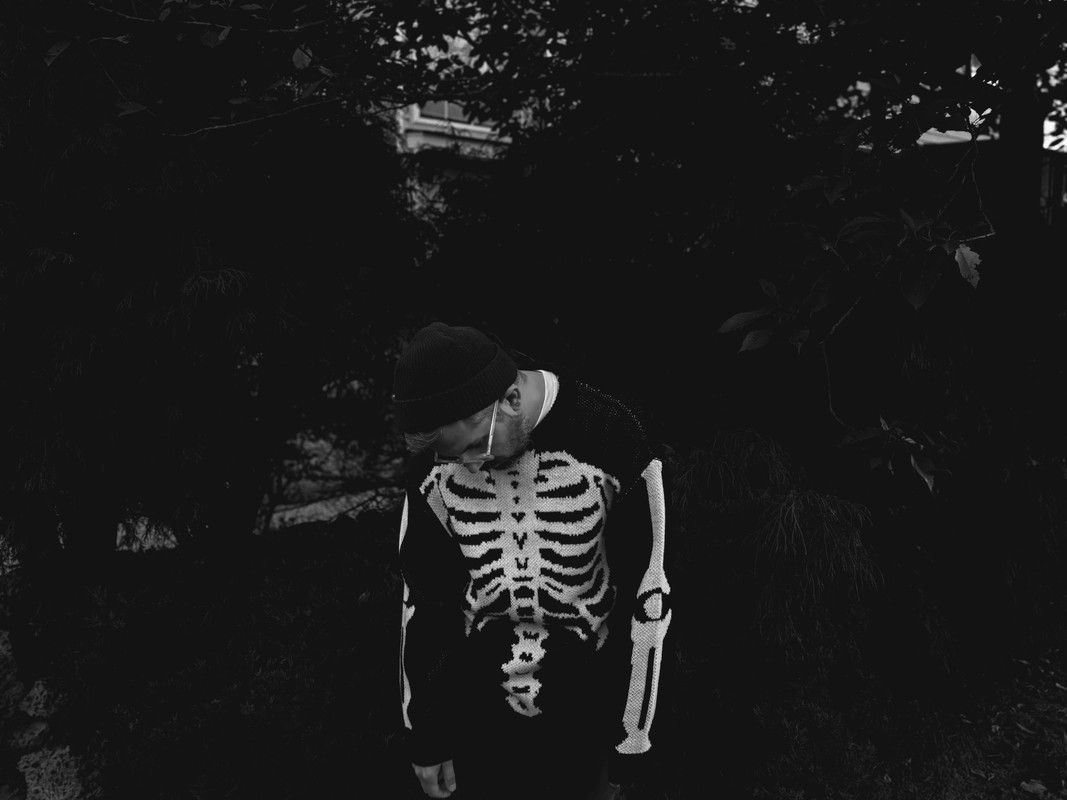
Caleb L'Etoile is a Virginia-based multi-instrumentalist and producer known for his genre-fluid approach and ability to weave together grief, humor, and a DIY punk ethos into his work. In this interview, he discusses his creative process, the unique friction in his music, and the horror anthology concept behind his fifth album, PS.
Tori: You write music the way others write ghost stories. What specific elements of a great ghost story are you intentionally trying to capture in a three or four-minute song?
Caleb: I think a great ghost story needs to be punchy, engrossing, and surprising. You have a limited amount of time to get an emotional reaction from your audience and you’re using atmosphere, characters, and events to accomplish those goals. Each of these songs strives towards the same goals. I want them to be punchy and sticky (like a good pop song). I want them to tell a richly detailed story that invites you in and helps you to see the world they’re describing. And I want them to create excitement by having a twist or element that you weren’t expecting at the start of the song.
Tori: Where do you feel the most tension or opposition exists in your music, and how do you harness that friction to create something lasting?
Caleb: I’m drawn to tension — I like when a song feels like it’s smiling through its teeth. A lot of my music sounds upbeat on the surface, but the lyrics are often dark or sad, and that clash creates this weird emotional friction. I’m also interested in pairing sounds you don’t usually hear together — like the character-driven vocals and blown-out textures on "Darling Pt. 2," or the goth Bloc Party energy running underneath the lighter melody of "When She Sings."
On PS, most of the tension lives inside the stories themselves. The lyrics drive the narrative, and the arrangements mirror that — constantly building, transforming, and releasing. The electric guitar leads act like pressure valves, releasing everything that’s been held back into moments of change and chaos.
Tori: Arthur Russell, mewithoutYou, and Modest Mouse are noted influences. What lesson or quality do you feel you pulled from each of those artists that helped shape your own distinct voice?
Caleb: With Modest Mouse and mewithoutYou, their influence shows up most in my lyrics and vocal delivery. I have what I call my “Modest Mouse voice,” and my talk-sing moments are basically my humble attempts to channel the inimitable Aaron Weiss. Lyrically, both of those bands set a standard I’ve always chased — I think of Modest Mouse, mewithoutYou, and Why? as the holy trinity of lyric writing. They taught me how to use words as texture, rhythm, and storytelling all at once.
Arthur Russell’s influence hits me in a different way. He’s a huge inspiration compositionally and artistically. I love how he builds a world around each idea — how his songs can be tender and cryptic at the same time. He’s genreless, deeply personal, and driven by instinct.
Mostly though, I love how everything by each of these artists feels like it couldn’t have been made by anyone else. They’re all unique authentic voices writing songs that only they could have written, and I think that’s cool as shit.
Tori: You proudly self-identify as genre-fluid and treat each song as an experiment. Is there ever a fear that this constant shape-shifting might alienate listeners who are looking for a more consistent sound, or is that risk integral to your artistic mission?
Caleb: I think a lot of what I do risks alienating people — whether it’s shifting genres, writing about strange or uncomfortable things, or experimenting with weird sounds and production choices. But honestly, that’s part of the fun. I once read Tony Wolski from The Armed talking about how he loves music that feels dangerous, and that stuck with me. I like when something feels unpredictable — when you don’t know what’s coming next. That sense of danger makes the whole thing more alive.
Of course I also worry about losing people sometimes, but I’ve made peace with it. I write the songs the way they come to me because that’s when they feel the most honest. At the end of the day, I’m the audience I’m writing for — if it excites me, then it’s working. If others connect with it too, that’s a happy bonus.
Tori: Your work is noted for letting grief and humor share a room. How do those two seemingly opposing forces interact within your songwriting process? Do you find that humor is a necessary survival mechanism when exploring themes of loss or collapse?
Caleb: Comedy and tragedy are never that far apart — in life or in my music. Take "Done With Living" from Mouthful of Teeth: it’s a song about not wanting to be alive anymore, but it faces that emotion head-on while still finding humor in it. It’s a tricky balance — it could easily go wrong — but that tension is what makes it interesting. Too much darkness can be suffocating; too much humor can feel empty. The friction between them gives the work a pulse.
Music itself is built on contrast — tension and release, loud and quiet, dissonance and resolution. Humor and grief work the same way. They sharpen each other. There’s something funny in the extremes, in how far emotion can swing. Like at the end of "Come Back Baby," where all that longing and hope collapses into one absurd, violent line — it’s awful, but there’s also a dark laugh in the shock of it. Those moments feel honest to me — because real emotion is rarely just one thing.
And yes, I do think humor is a necessary mechanism for survival, especially in 2025 when survival is becoming more and more important while certain people burn away whatever feeling of safety we’ve held illusions for up to now. You can either stay scared or zoom out and laugh at how bizarre it all is. If a monster eats someone’s face, sure that’s terrible, but it’s also kind of like, ‘Whoa! That person just got their face eaten off!’ which is rife with humor as long as it’s not your own face.
Tori: As a Virginia-based multi-instrumentalist and producer, how does having total control over every aspect of a track—from the initial lyric to the final mix—change the way you approach composition?
Caleb: Being an all-in-one shop, the biggest influence and effect would be time. It allows me to work fast and decisively, cueing in on what I’m finding interesting at the moment, and exploring that in full throughout the song. It allows me to be experimental and to fully realize a vision in a way that I’ve never had the opportunity to in working with other people. Given, there’s a tradeoff, and I’m missing out on some amazing musicianship and potential ideas when I’m not taking input from other contributors, but being able to work and write at the speed I do is really important to my workflow and helps to keep me happy and sane. Most of these songs end up having a set way they need to be as dictated by my brain too, and working solo allows me to sit with them and help them be the songs they want to be.
Tori: When you begin writing, are you starting with a melody, a lyric, or a visual image that sets the scene for the song's story?
Caleb: Each song tends to be a little different. Some songs start with a lyric idea, some with a drum pattern, others a riff—most of the songs on PS in particular started with a guitar riff that was then repurposed to a bass riff. The lyrics (which tend to come in tandem with the vocal melody) need to present themselves to me quickly though, or the song gets tossed in an ‘ideas’ folder and often not touched again. I’m a big proponent of first thought/best thought ideology, so I will take whatever jumping off point my brain is cooking up at the time and try to suss it out like I’m uncovering an artifact or solving a puzzle.
Tori: Does being based in Virginia—away from major industry hubs—influence the "DIY punk energy" that is central to your work, both sonically and philosophically?
Caleb: I think that’s fair to say. The relative isolation of Virginia, being away from major cities and cultural hubs, has taught me to be industrious and self-reliant. If I need to do something, I need to be able to do it myself or else it’s going to take extra time and resources, which I often don’t have. It’s also contributed to my productivity. The country can be quiet, so I spend most of my time writing music and trying to refine my craft.
DIY is a crucial part of punk philosophy for me (as is community, which I’m missing here), and it’s become very important to me to make these songs myself. I made every part of these records, and I don’t think they could have been made by anyone else or by any other method. I think that’s cool, and being able to do the things I’ve done, inspires me to grow and reach for bigger things I might have thought unobtainable otherwise.
Tori: What's the most challenging or uncomfortable emotional territory you've explored in your songwriting that ultimately yielded a track you are most proud of?
Caleb: I think my whole American Death album was likely the most challenging and uncomfortable thing I’ve made. There are a couple of reasons. Generally, I dislike protest music and have never wanted to be branded as making such (though I think modern protest art is necessary for what we’re going through as a people). I also really dislike conflict, so speaking out against things is very against my nature and tends to give me a lot of paranoid thoughts and anxiety about the many ways it could go wrong. Especially with the current administration. But it felt important and necessary at the time of writing, so that’s what I did. I think the tension of speaking out paired with the personal depths I tend to explore lyrically created some really interesting work that serves as a conduit to show you how I was feeling at the time, as opposed to simply telling it. And that’s the kind of art I’m interested in making. I want you to feel things rather than just hear them. Songs are like little spells that you can cast on people when you do it right. You can make people feel happy, sad, wistful, conflicted…it’s a really cool thing, especially as a means to capture a time and place.
Tori: Tracks like “KEROSENE,” “Aw Hell,” and “Death Rattle” are all very different. Beyond your voice, what is the single unifying "fingerprint" that makes each of these tracks unmistakably Caleb L'Etoile?
Caleb: It’s funny to think of my voice as the unifying thread, because that tends to shift a lot from song to song too. I think the real fingerprint is in the production — the textures, the pacing, the way things are glued together. Even when the sounds themselves differ, they all pass through the same filter of how I hear the world. My songs are usually vocal-forward, built around distortion, tension, and surprise. They can be messy or tender, but they always aim to pull you into a world that feels alive and a little unpredictable.
I’m also not interested in making an album where every song sounds the same, and I’m definitely not interested in making 2 albums that do the same thing. That kind of repetition feels safe to me, and I’m more drawn to risk. Following curiosity keeps the work honest and makes the music more engaging, even if it takes people somewhere unexpected.
Tori: Your fifth album, PS, is conceptualized as a horror anthology in song form. Can you walk us through that core concept? Is the dread based on classic tropes or on the modern, everyday anxieties we find in your previous work?
Caleb: Since I started this [self-titled] project, one of the big goals has been to do an EP of Halloween music each year. That’s what PS started out as as well. I began with some covers and wrote a couple songs, and then I caught the notion of making something bigger and more cohesive that could be more powerful as a whole than just a collection of seasonally inspired songs.
That’s when PS was truly born. I wrote the song "Starling" and was really intrigued by the sound world and narrative of the song. I hadn’t explored post punk in this way, and most of the songs I’d written up to now have been about myself in either direct or varying degrees. So what if I made a whole album that sounded like it came from the same town, and what if that town was full of creatures, both human and non, that each had their own story and flavor. As I wrote, each song became a little vignette, and as the concept opened to me, those songs became horror movies, all culminating in anthology form like some of my favorite movies—Trick R Treat and Scary Stories to Tell in the Dark come to mind in particular (though if I do this again I’ll probably take influence from there and try to make it so the stories all tie together more closely).
Most of the dread is based on more classic tropes. I had a few songs I knew I wanted to write—a Frankenstein song, a beach monster a la Creature From the Black Lagoon, witches, vampires, etc.—and the rest kind of came naturally, thinking on humans and the violence they’re capable of.
Tori: How did you balance both dread and camp? Which track on PS leans furthest into pure 'camp,' and which one delivers the most genuine sense of 'dread'?
Caleb: Balance was something I needed to keep in mind throughout this record. I didn’t want to go fully dark, and I definitely didn’t want to go full silly. Halloween for me is a meeting of those two emotions, and most of my favorite horror movies make great use of both. Songs like "Darling Pt. 2," "Come Back Baby," and "Beach Horror," I think, balance this the best and serve as some of the album’s most inviting entry points. But balance needs to exist for the album too, so some songs lean fully into one or the other with the intention of the work feeling balanced as a whole within the summation of its parts.
"ZBF" and "Beach Horror" are definitely the album’s campiest moments, with the former being dumb silly fun in line with something like the "Monster Mash," and the latter building humor more into the presentation of the character and a dumb, but fun refrain.
In terms of dread, it’s definitely "A Haunting." That song is really intense and probably the darkest thing I’ve written to date. I wanted that song to feel like you’re living in a horror movie and the sound prompt was for it to feel ‘harrowing’. The relentless drums and the wall of noise definitely helped to heighten that feeling and pair well to enhance the darkness of the narrative.
Tori: For the PS album, if each song is a self-contained miniature horror story, what is the mood or 'setting' of the overall house this anthology takes place in?
Caleb: The house of PS is definitely haunted — but not just by ghosts. Some rooms feel heavy and bleak, others carry a flicker of hope, like sunlight through a boarded window. There are parts of the house that are lively, even playful, and others that you probably shouldn’t open the door to. It’s spooky, and a little nerve-wracking, but still fun in that Halloween kind of way.
Tori: In what specific ways—musically or thematically—do you feel PS pushes you further as an artist compared to your previous work? Was there a new instrument, production technique, or lyrical approach you experimented with on this record?
Caleb: PS pushed me in a lot of different ways. In some respects, it’s my most straightforward record, but that simplicity was its own experiment — learning to say more with less. I also started writing more from characters’ perspectives as opposed to being inward focused. Musically, I leaned into loud, brash guitar leads as moments of transformation, and I built a lot of songs around bass lines instead of just using the low end to support the other instruments. I also had to unlearn certain instincts from working in electronic and pop spaces. This was a punk record — raw, impulsive, and chaotic — and I had to trust that imperfection could carry its own kind of truth.
And for any gear nerds, I have to shout out the Motor Pedal by Gamechanger Audio. It has an actual motor that spins to match the pitch you’re playing, and it creates these wild, mechanical overtones. I used it on almost every track; it became the defining tone for the big lead moments across the album.
Tori: With PS out now, what single message or feeling do you hope listeners take away after they've finished wandering through all the haunted rooms you've built on this record?
Caleb: I hope they’ve had fun by the end of it. PS was never meant to deliver a message — it’s more like a guided tour through a haunted house. There are moments of fear, humor, chaos, and release, all meant to capture that strange joy of Halloween. It’s an invitation to step into something eerie and theatrical, and to enjoy the ride along the way.


Comments
Post a Comment